Human in the Loop Got AI Approved. Now It's the Bottleneck.
AI drafts the memo in minutes. The expert reviews it in an hour. The fix isn't fewer people. It's moving them up the loop.
Siva Darivemula··6 min read
Monday, 8:05 a.m. The agent finishes a credit memo for a $1.2 million equipment loan. Financials spread, ratios checked, covenants summarized. It took a few minutes.
Then the memo waits.
The senior credit officer gets to it at 9:30. They know this borrower, this industry and the last two times the numbers looked like this. They read, check, ask two questions and approve at 10:30. An hour, well spent.
Eight memos on a good day. The agent could draft eighty.
Next week, the officer is on vacation. The agent keeps drafting. Nobody approves. By Friday, the queue is the story.
The call
A few weeks after my last post, Stop Asking AI Agents to Behave, a new client called. They're a Microsoft shop. They'd seen my demo, where a person approves the agent's riskier moves, and they'd been wrestling with the same problem for some time.
Their question wasn't about permission anymore. Governance as code answers that. It was about people. If every important output waits for an expert, how do you ever scale?
I didn't have a complete answer. So I went looking, and talked to people who know this space far better than I do.
The deal that got AI approved
Here's what I realized first. Human in the loop was the deal that got AI approved: keep a person on every output, and risk signs off. It worked. It's also why so many pilots stall at the same volume.
And the loop is thinner than it looks. Anthropic found people approve 93% of permission prompts. In September, researchers showed an approval screen can display one action while running another. A reviewer who approves almost everything, on a screen that can lie, isn't the protection we think it is.
You can't hire your way out. The officer is the scarcest person in the building. You can't take them out either. They carry the expertise, the accountability and the regulator's trust.
So the question changed. Not whether people stay in charge, but where they spend their judgment.
Discovery one: move people up the loop
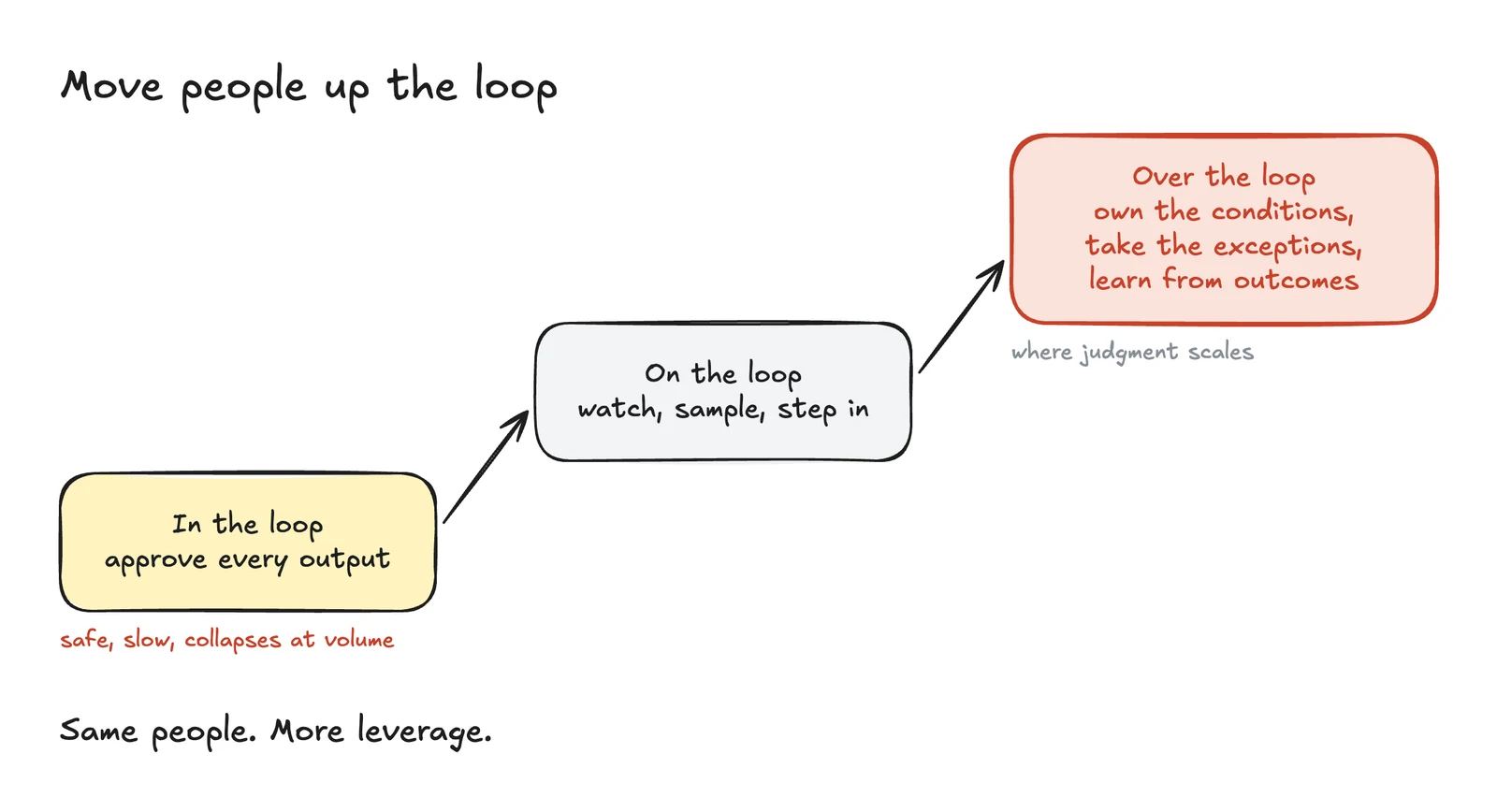
The people I spoke with kept describing the same climb.
- In the loop, people approve every output.
- On the loop, the agent acts, and people watch, sample and step in.
- Over the loop, people own the conditions, take the exceptions and learn from outcomes.
Anthropic's own users already climb it. As people gain experience, full auto-approval rises from about 20% of sessions to over 40%, and Anthropic concluded that effective oversight "doesn't require approving every action."
Same officer. More leverage.
Discovery two: banks solved this long ago
The second surprise: none of this is new. Banks scale judgment every day.
Nobody at a large bank approves every loan by hand. Credit authority is delegated by role and limit, so a decision doesn't wait on one person's calendar. The OCC wants auto-approval criteria "approved by the appropriate level of management," with "a clear audit trail." The vacation problem, solved on paper long ago.
And when models started making decisions, banks didn't put a person on every one. For 15 years, SR 11-7 told them how to govern the model instead: limit where it's used, challenge it independently, compare its decisions to outcomes, and track every time people overrule it.
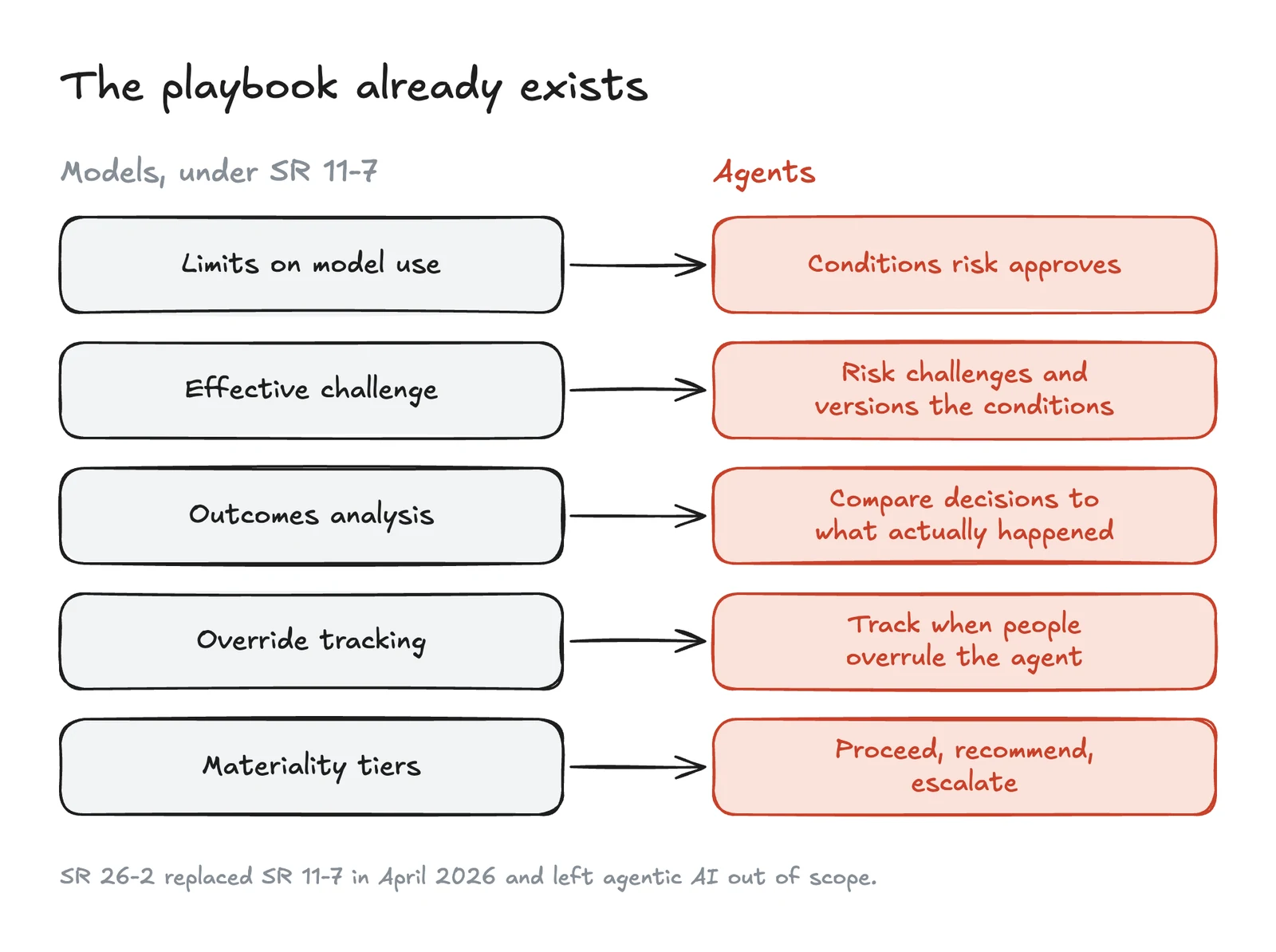
In April, regulators replaced SR 11-7 with SR 26-2 and set agentic AI aside as "novel and rapidly evolving." There's no rulebook for agents yet. But there is a playbook, and it works well beyond banking.
Discovery three: rules that remember
The last piece was technology. Last time, I covered two legs of agent governance: controls and isolation. Moving people up the loop needs a third.
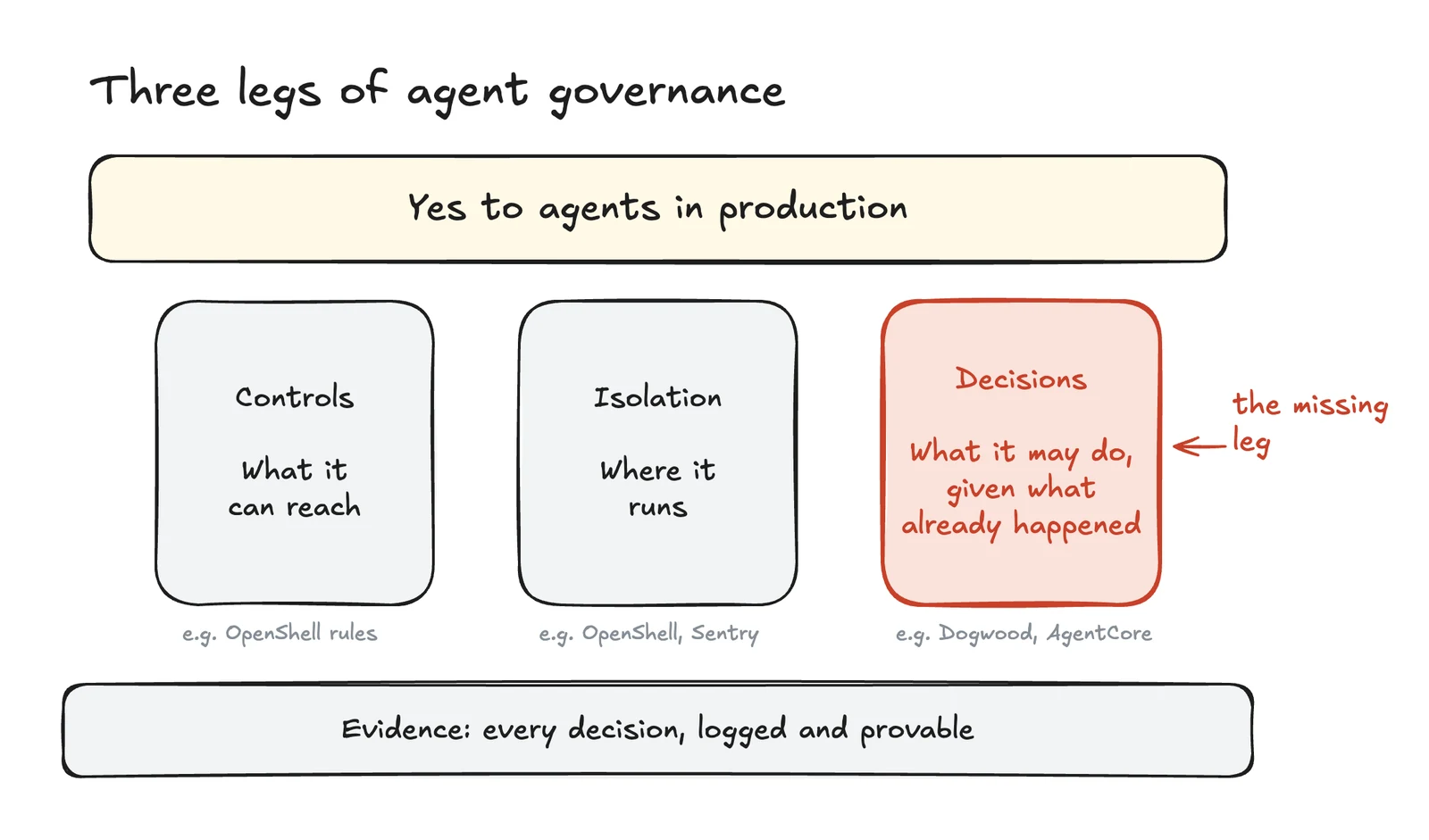
Conditions depend on history. Were the financials refreshed before the memo was drafted? How much has moved forward today without a person? Did a named officer approve this borrower in the last day? Most agent policy checks one request at a time. It can't answer those.
In August, AWS open-sourced Dogwood, a policy language whose rules read what the agent already did. AgentCore Policy runs it as a managed service. Microsoft's open-source toolkit now ties each approval to the exact action and policy version. The OpenID Foundation drafted a standard along the same lines. Different companies, same idea.
Monday, replayed
Now run that Monday again.
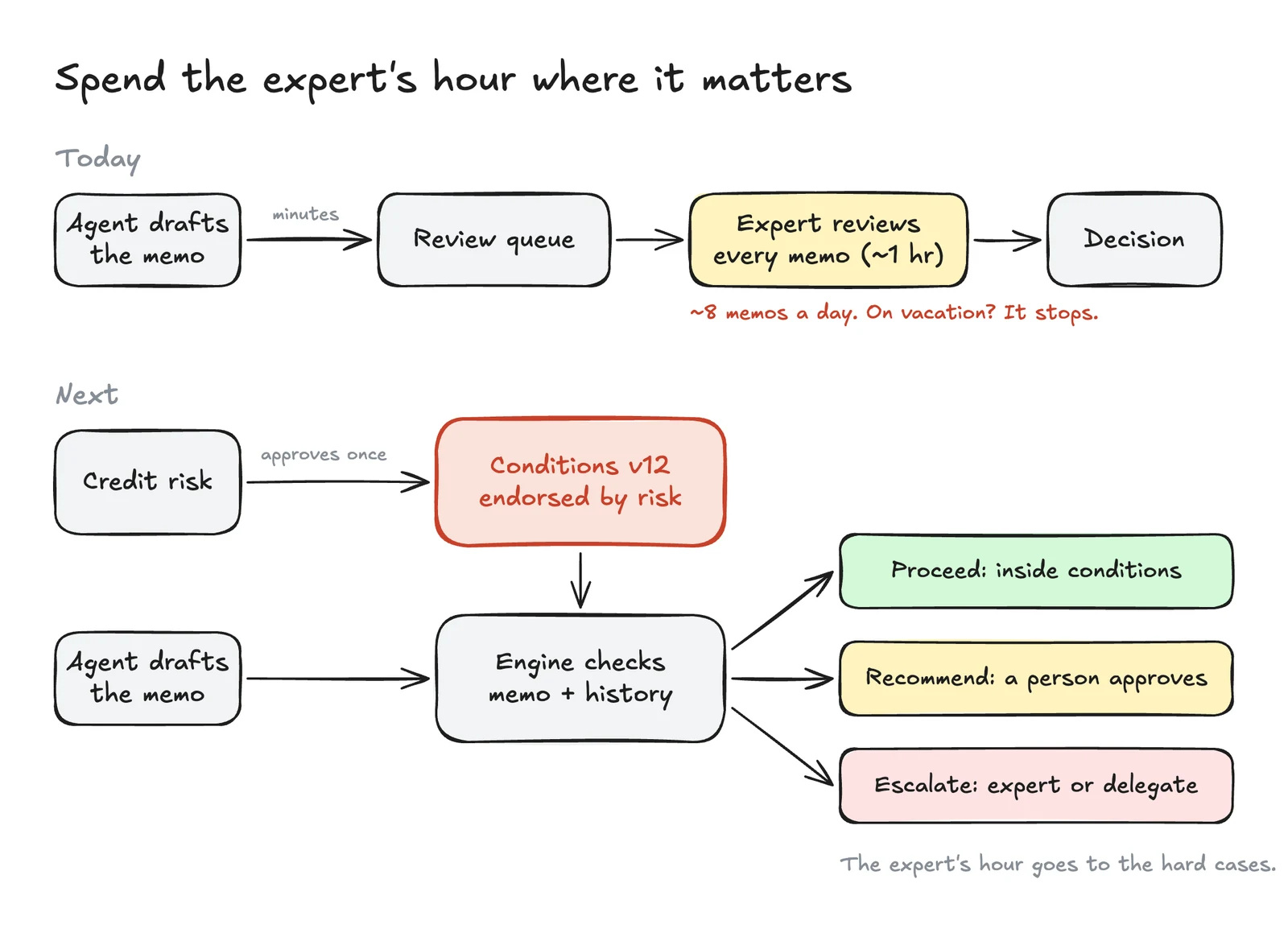
8:05. A small renewal. Same collateral, fresh financials, well inside the conditions risk approved. The agent moves it forward and records why.
8:20. A memo near a concentration limit. The agent assembles the case and recommends. A credit analyst approves in minutes.
8:40. Something new: an unusual structure, outside policy. It escalates to the officer, who's on vacation, so it goes to the delegate who holds that authority this week.
The officer's hour goes to the hard case. The vacation is just a vacation.
And every decision leaves proof: the exact action, the version of the conditions and the history that met them.
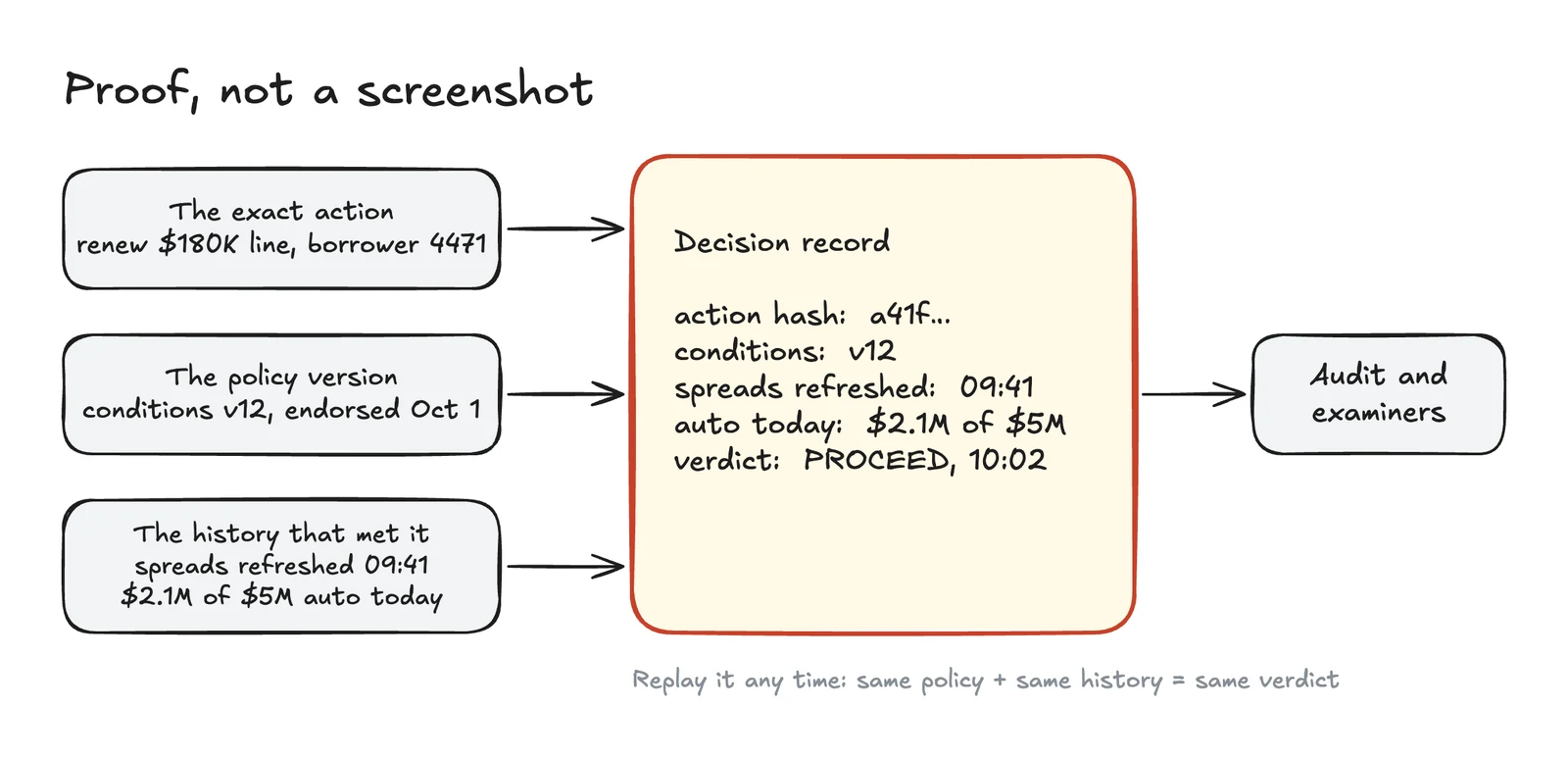
That record is how the officer stays over the loop. Compare what moved forward with what happened next. Watch how often people overrule the agent. When overrides climb, change the conditions, exactly what SR 11-7 asked of models.
Where this goes
It's early, and it isn't one product yet. On AWS, you can buy the decision layer. Everywhere else, you build it, which puts build versus buy back on the agenda.
If I were starting tomorrow:
- Measure the gap between time to produce and time to review. That gap caps your adoption.
- Write down what your best expert checks, then run the agent in shadow against it.
- Watch the overrides. They tell you the conditions are wrong before the outcomes do.
Next in the demo, I'm testing a sixth control: the agent proceeds when the conditions are met and routes to a person when they aren't, with the decision record attached. And for the client who called, the next post covers what this takes on Azure.
What would your best expert hand off, if they could write the conditions?
Try the demo or tell me what you're seeing.
Sources
- Anthropic, Claude Code auto mode, March 25, 2026: users approve 93% of permission prompts.
- Anthropic, Measuring agent autonomy, February 18, 2026: full auto-approval rises from about 20% to over 40% of sessions with experience.
- A. Arun Kumar, Loopjacking: Hijacking Human-in-the-Loop Approval, arXiv, September 17, 2026.
- OCC, Comptroller's Handbook: Lending and Loan Portfolio Risk Management, June 2026.
- Federal Reserve and OCC, SR 11-7: Supervisory Guidance on Model Risk Management, April 4, 2011 (archived copy).
- Federal Reserve, FDIC and OCC, SR 26-2: Supervisory Guidance on Model Risk Management, April 17, 2026.
- AWS, Introducing Dogwood, August 6, 2026, and AgentCore Policy temporal policies.
- Microsoft, Agent Governance Toolkit ADR-0030: action-bound approvals, September 13, 2026.
- OpenID Foundation, AuthZEN working group drafts for the agent era, June 15, 2026.
Questions
- Why is human in the loop becoming a bottleneck for enterprise AI?
- AI now produces work in minutes that still takes an expert about an hour to review. Review time caps volume, work stops when the one expert is out, and reviewers who approve nearly everything (Anthropic found 93% of permission prompts get approved) stop adding judgment. The more AI an enterprise adopts, the longer the review queue.
- What does it mean to move people up the loop?
- Shifting people from approving every output (in the loop) to monitoring and stepping in (on the loop) to owning the conditions an agent must meet, taking the exceptions and learning from outcomes (over the loop). The same experts spend their judgment where it matters most.
- How do banks scale human judgment?
- Through delegated authority, which sets approval limits by role so decisions don't wait on one person, and model risk management, which governed models that make decisions under SR 11-7 from 2011: limits on use, independent challenge, outcomes analysis and override tracking. SR 26-2 replaced SR 11-7 in April 2026 and left agentic AI out of scope, but the playbook carries over.
- What is AWS Dogwood?
- An open-source policy language AWS released in August 2026. It extends Cedar with rules that read an agent's history, such as whether an approval happened in the last day or how much moved forward today. Amazon Bedrock AgentCore Policy runs it as a managed service.
- Where should an enterprise start?
- Measure the gap between how long AI takes to produce work and how long people take to review it. Write down what the best expert actually checks, run the agent in shadow against those conditions, then let the lowest-risk tier proceed and watch the override rate.